
Why Are Bee Suits White? The Science Behind Beekeeping Colors
The real reason beekeepers wear white — and whether khaki, tan, or other colors are just as safe.

White is the traditional color of choice for beekeeping suits.
Quick Answer: Why are bee suits white?
Bee suits are traditionally white because honey bees instinctively associate dark colors (black, brown, navy) with natural predators like bears and skunks. Wearing white keeps colonies calmer and reduces defensive stinging behavior during hive inspections. Other light colors like khaki and tan are also considered safe.
The Science: Why Bees React to Dark Colors
Honey bees evolved over millions of years alongside natural predators — bears, skunks, badgers, and other animals that raid hives for honey and larvae. Almost every one of these predators shares one trait: dark fur or dark coloring.
Over generations, bees developed an instinctive defensive response to dark, moving shapes near their hive. This isn’t a learned behavior — it’s hardwired. A colony doesn’t need a bad experience with a black jacket to react defensively to one; the instinct is built in.
Researchers studying honey bee vision have found that bees see color differently than humans. They’re highly sensitive to contrast and specific wavelengths, and dark colors (black, brown, dark red, navy) register as “predator-like” far more than lighter colors.
What This Means for Your Bee Suit
When you wear a dark-colored suit into the apiary, you’re inadvertently triggering the same defensive instinct bees use against bears and skunks. This can result in:
- More guard bees investigating and bumping into you
- Higher likelihood of defensive stinging behavior
- A more agitated colony during your entire inspection
- Longer time for the hive to “calm down” after you leave
None of this means a dark suit will definitely result in stings — plenty of beekeepers wear darker gear without major incident, especially with calm colonies. But why take the risk when lighter colors are proven to reduce defensive behavior?
Is White the Only Safe Color?
This is where a lot of beekeeping advice oversimplifies things. White isn’t the only acceptable color — it’s simply the most traditional and the safest choice for maximum calm. Here’s the real breakdown:
✅ Safe Colors (Low Defensive Response)
- White — the gold standard, maximum calming effect
- Khaki / Tan — falls within the safe range, doesn’t trigger defensive behavior
- Light Grey — generally safe
- Pale Yellow — safe, though less common for suits
❌ Colors to Avoid
- Black — highest defensive trigger, closely resembles bears and skunks
- Dark Brown — similar risk to black
- Navy Blue — reads as “dark” to bees, avoid
- Dark Red — bees see red differently than humans; it can appear dark/black to them
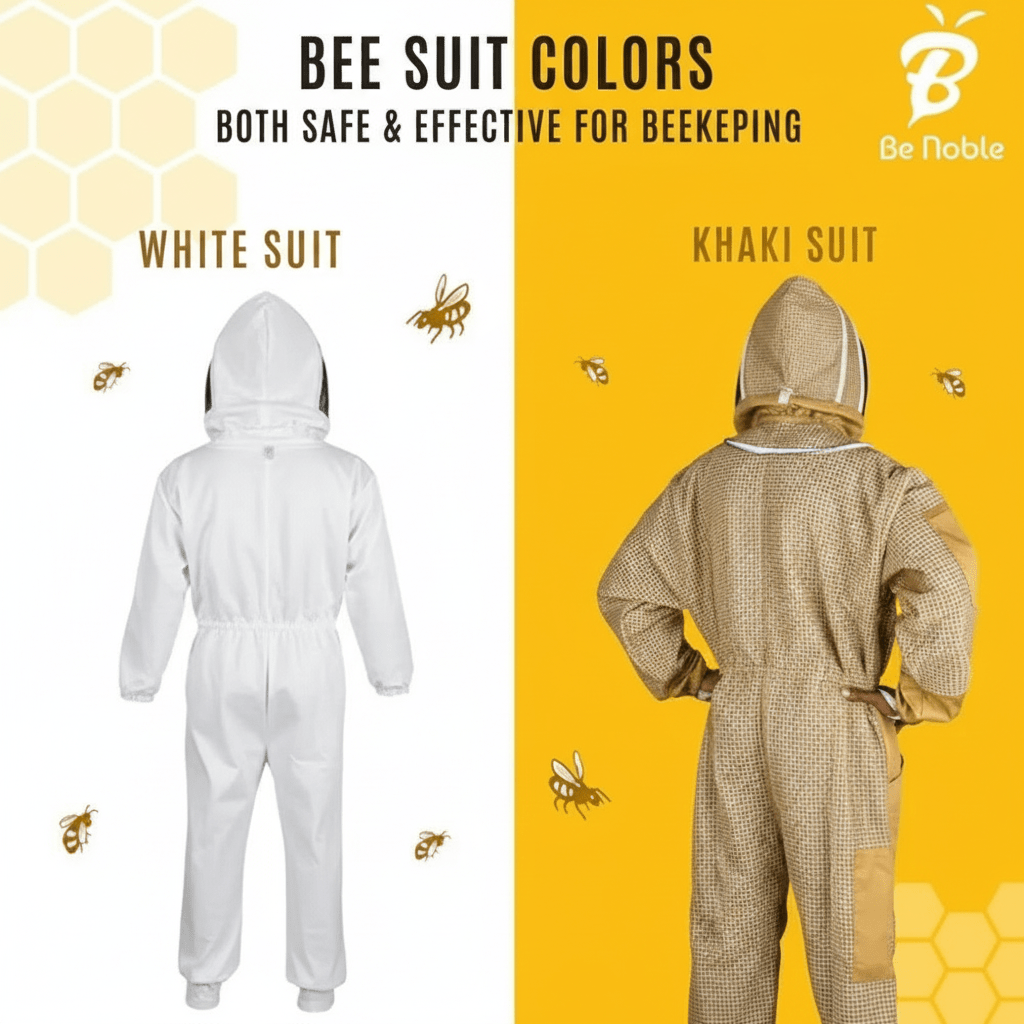
So if you’re choosing between a white bee suit and a khaki bee suit, you’re not choosing between “safe” and “unsafe” — you’re choosing between two suits that are both within the safe range, with slightly different practical trade-offs.
White vs. Khaki: Which Should You Actually Choose?
Since both colors are safe, the real decision comes down to practicality:
| Factor | White | Khaki |
|---|---|---|
| Bee calmness | Maximum | Very good (safe range) |
| Heat reflection | Best — stays coolest in direct sun | Good, slightly warmer than white |
| Stain visibility | Shows every mark | Hides propolis, honey, dirt |
| Best for | Hot climates, beginners, visibility | Daily/commercial use, low-maintenance |
If you’re a hobbyist beekeeper doing occasional inspections in a hot climate, white is the classic choice. If you’re doing daily hive work and don’t want to wash your suit every other day, khaki is the more practical pick — without sacrificing safety.
Does Suit Color Matter More Than Suit Quality?
Quick Answer: Does bee suit color matter more than construction?
No. Suit color affects how defensive your bees become, but suit construction (fabric layers, sealed closures, proper fit) is what actually prevents stingers from reaching your skin. A well-built khaki suit protects just as well as a white one — color is a secondary factor, not the primary safety feature.
What actually determines sting protection:
- Fabric thickness and layer count (single-layer vs. 3-layer ventilated mesh)
- Sealed closures at wrists, ankles, and neck
- Veil quality and fit
- Overall suit fit (too tight = fabric presses against skin = stings get through)
What About Other Beekeeping Gear Colors?
The same color principles apply to jackets, veils, and gloves:
- Veils: White or khaki mesh is standard and safe. Avoid dark-colored veil frames if possible.
- Gloves: Most beekeeping gloves come in tan or light leather tones — naturally within the safe color range.
- Jackets: Same rules as full suits — white or khaki, avoid black or navy.
Common Myths About Bee Suit Colors
Myth: "Any bright color works — bees just hate dark colors specifically"
Reality: It’s specifically about mimicking predator coloring (dark fur patterns), not brightness in general. A bright red suit can actually appear dark to bees due to how they perceive that wavelength.
Myth: "Bees can't see color at all"
Reality: Bees have excellent color vision — arguably better than humans in the UV spectrum — they just see a different range of the color spectrum than we do.
Myth: "Suit color doesn't matter if you're experienced"
Reality: Defensive instincts are biological, not something bees “get used to.” Even experienced beekeepers benefit from wearing suit colors that keep colonies calm.
Frequently Asked Questions
Can I wear a black bee suit if I'm careful?
Why do some professional beekeepers wear khaki instead of white?
Does the color of my veil matter as much as my suit?
Will a white suit guarantee I won't get stung?
What color should beginners choose?
The Bottom Line
Quick Answer: Summary: Why are bee suits white?
Bee suits are traditionally white because it’s the color that keeps honey bees calmest, thanks to their evolved instinct to associate dark colors with predators like bears and skunks. White isn’t the only safe option — khaki, tan, and light grey all fall within the acceptable range. What matters most is avoiding true dark colors (black, navy, dark brown) and choosing a suit with solid construction: multi-layer fabric, sealed closures, and a proper fit.
Shop Be Noble Bee Suits
Ready to suit up? Be Noble offers premium bee suits in both white and khaki, built with 3-layer ventilated mesh for maximum sting protection and breathability.